




Bunnies - they’re not just our friends, they’re our… fertilizer machines?

May 8th, 2008

Although it’s not typically a subject we use to promote SaveABunny, we thought we knew everything about… well, rabbit droppings. But we recently learned something new: It may not be a pretty job emptying the litter boxes of 100+ rabbits every day, but all that bunny poo can actually be used to make our gardens prettier.

It makes sense if you think about it – bunnies in the wild eat plants all day, so naturally what goes back into the ground would help the plants be healthier – making more food for bunnies. Nature is full of these beautifully effective recycling systems.

Here’s what we learned from Sloat Garden Guru:

“Rabbit droppings as well as their bedding and uneaten food do in fact
make excellent fertilizer/compost. The easiest method would be to passively
compost the cage cleanings in a large rubber/plastic garbage can in which
holes have been drilled on the bottom and sides. Kitchen scraps are welcome
additions (no meat or orange peel) Passive Compost means you don’t turn it.
Active is when you stir it.The bottom of the can should be in contact with
the earth and the lid should fit snuggly. The holes at the bottom allow
natural soil bacteria, decomposing fungi and beneficial bugs and worms to
gain access . Watering is probably not necessary. By this method, you could
possibly have 2 to 4 “crops” a year. Apply this rich compost around any and
all plants in spring, summer and fall. Vegetables, annuals, and flowering
shrubs will benefit the most.You will know it’s ready because it will have
turned brown and will smell earthy.”

SaveABunny at the PFAC conference

May 7th, 2008

Thanks to a very generous donation from one of the directors of PFAC (Professional Fiduciary Group of California), we will have a booth at their conference this year to educate people about rabbits as indoor companions for home bound people.

(If you’re curious as to what exactly a fiduciary is, we looked it up the PFAC website: “A fiduciary is a person who assumes responsibility for a position of trust. …Fiduciaries serve by court appointment as guardians, conservators and personal representatives of estates. They also serve by agreement as trustees, representative payees or as agents under powers of attorney.”)

Each person that a PFAC fiduciary represents has a live-in caregiver. At SaveABunny, we think rabbits as companion animals would both benefit the quality of life for people in care programs, as well as provide a foster and volunteer resource for our rabbits. It’s an interesting new direction for us that we’re excited to be exploring.

The conference is being held at the San Francisco Airport Marriott in Burlingame. Exhibit hours are Wednesday, May 7th 3:00 to 6:00 p.m., Thursday & Friday May 8th and 9th 8:00 to 4:00 p.m. Learn more at the PFAC website.

Part of the inspiration for the donation was the work we do with one of our bunnies, Scooter, for special-needs groups like Blind Babies. Check in soon for a blog about Scooter and the important work he does.

Saving Bunnies.

May 4th, 2008

When you go to the SaveABunny website, on the surface we might look like a bunch of bunnies looking as cute as possible (which is really not that hard) to get adopted into loving homes. But behind all the floppy ears and purple web pages, we’re a team of hard-working, dedicated humans. We spend our days - and nights - making sure bunnies all over the Northern California get the second chance they deserve.

So as our first SaveABunny Blog post, I’d like to share a little piece of what goes into saving bunnies on an average day. (Also, I should introduce myself. I’m Thea – volunteer writer. I squeeze in writing for the website and this blog, among other things, into my schedule as a part-time student and copywriter at a local ad agency.)

Last Thursday, Marcy, the founder and head cheerleader of SaveABunny, and I made a stop at San Francisco Animal Care and Control. The shelter was overcrowded and they’d given us a call asking for rescue assistance. It was my first time visiting this (or any) animal shelter, but Marcy is a regular there. The staff all know her, and greeted us with a casual familiarity. They were kind enough to let us drop in well after closing hours, around 7:45. Having just come from a SaveABunny team meeting, were more rushed than we should have been. Lights-out was at 8, but squeezing in those few minutes to check out the new bunnies would mean a world of difference for some of them.

You see, while SaveABunny bunnies are promised love and care for their whole lives, whether they get adopted or not, most shelter rabbits have no such guarantee. Just like all the cats, dogs, rodents, reptiles and other animals that end up at crowded animal shelters, bunnies that don’t get adopted get euthanized. No matter how cute they are.

So our mission at Animal Care and Control was to meet the new bunnies that had arrived and get to know them a little, checking their health and temperament. Our immediate goal for rabbits there is to keep them from being euthanized. No one at San Francisco Animal Control wants to euthanize them – that’s why they call us – but when they run out of room for them, they don’t have a choice. We also post bunnies from local shelters on the website when we don’t have room for them at our facilities in Marin, because it increases their chances for adoption. If we’d had more time and more space, we would’ve taken a few of them with us.

There’s no set rule as to which bunnies we take into rescue – sometimes we’ll find one that has little to no chance of getting adopted, so we take him or her under our wing. Sometimes, we find exceptionally adoptable bunnies that would find homes quickly at a different shelter. Sometimes we meet bunnies that have been traumatized, and with a little hard work and a lot of love, we’re sure they’ll find a home. All they need is time. Unfortunately, it’s time that shelters just can’t afford to give them. So we take those ones, too, and hope that help will come forward.

We entered Room 225 at Animal Care and Control. It was a small room, with cages stacked higher than my head. There were about 13 bunnies in there – plus one guinea pig, a chicken, two rats, a tiny gray mouse and one quail that had been rescued from the back of restaurant. He pecked away happily at a bowl of seeds, occasionally letting out a curious “Squawk!”

We checked up on the bunnies one by one. They all had their own reactions to us – some excited, some timid, some just casually looking up between mouthfuls of the newspaper that lined their cages. Each and every cage had a sign with a big blue stamp on it: “AVAILABLE”.

Many of these were bunnies that Marcy had already met – and most of them looked like they had a decent chance of getting adopted. While she made sure they were all still doing fine, I asked her about the little quail in the corner.

She answered wearily, “Oh, he’ll probably be euthanized. It’s illegal to keep quails as pets, and he’s not releasable because he was raised for food.” According to California state law, no “wild animal” can be kept or sold as a pet. Wild animals are defined species by species, not case-by-case.

“So you mean no one can adopt him?”

“Nope. He’ll almost definitely be euthanized.” I know it’s as heartbreaking for her as anyone else, but she said it almost nonchalantly. I realized why – this happens to animals here (and everywhere else) every day. You just have to do what you can, knowing that you can never save them all. But I couldn’t help feeling especially bad for this little feathery guy. He’d been put in a catch-22 by a combination of well-meaning human rescue efforts and well-meaning human law.

At least bunnies are legal pets. That’s one thing that makes our job easier – and we have to count our blessings sometimes.

Marcy and I moved on to an even smaller room across the hall. If it had been earlier in the day, we would’ve spent some quality one-on-one time with each bunny, making sure they stay friendly and happy. They’re social animals, like dogs and birds (and people), so even the shy ones crave interaction and attention.

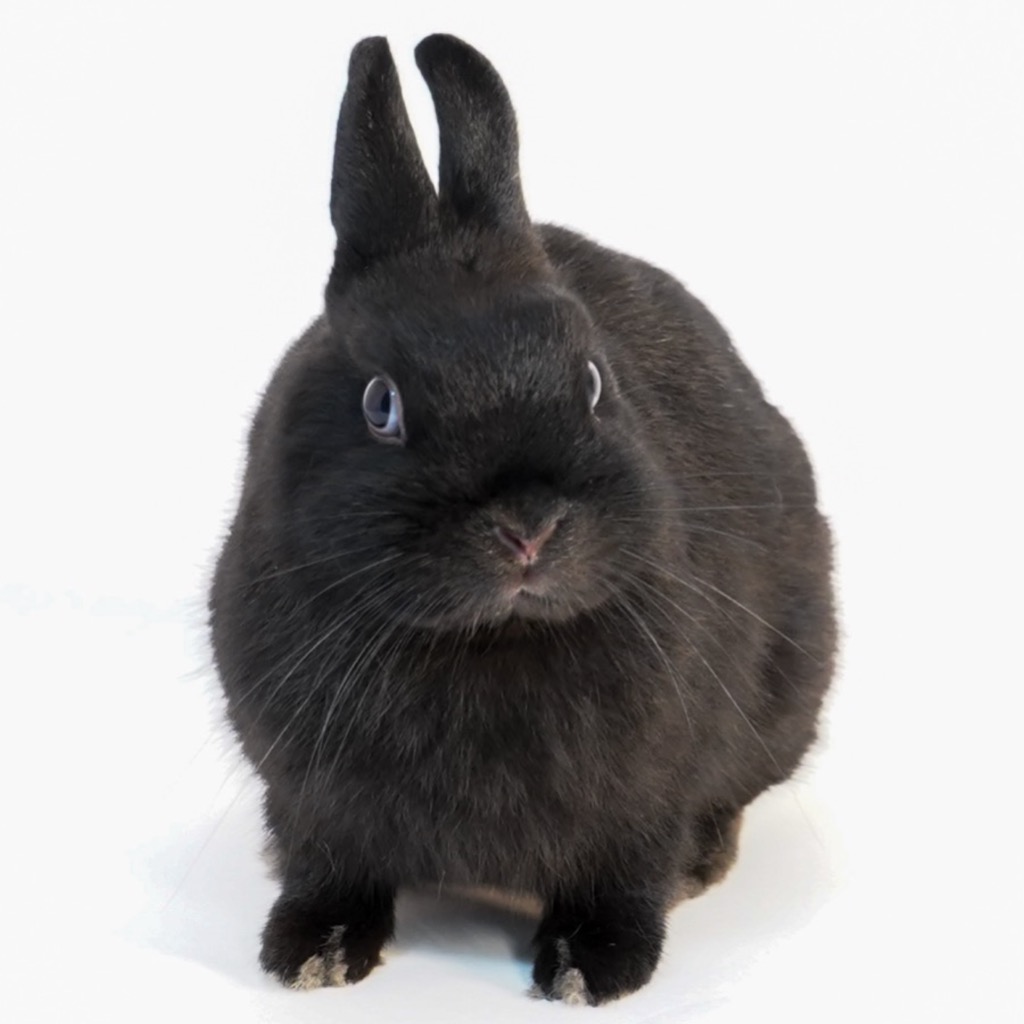
This tiny room was where the new bunnies were. Many of them had been bought at a local pet store and then left at the shelter when they were no longer wanted. They weren’t all as well off as the others. Two had just come back from surgery and had big signs on their cages asking to be handled extra gently. One gold flop-eared bunny was huddled in a corner, shivering. I wondered what had made her so timid. A little black dwarf rabbit had been mistreated a different way – she was grotesquely overweight; probably two pounds over her healthy 1.5 pounds. That’s like a human weighing 350 pounds.

Sophie, the overweight black bunny.

We took photos of each one and their charts, to review later. We checked them all for general health – clean, soft fur, healthy toes, and straight teeth. One of many new things I learned was that a bunny with crooked teeth is all but unadoptable; without expensive surgery, he won’t able to eat properly, and he’ll be malnourished. How expensive is the surgery?

“Hundreds and hundreds of dollars,” Marcy answered.

I also learned that there’s a trick to handling these bunnies – sweetness. Marcy took extra care to pet each one and say a few comforting words. A little rub around the ears can go a long way.

She took extra time with the gold flop-eared bunny. When you talk to them, for the most part it doesn’t matter what you say, (although bunnies can usually learn their own names, and possibly a few other words,) what seems to matter is that you’re gentle, soft-spoken and let your genuine concern show in your voice. Marcy had perfected these.

Cassie, the gold bunny, when we first came in.

“Hey honey, it’s ok, yeah. It’s ok. I’m sorry. People can really suck, huh? I’m sorry.” She said it softly over and over, and our flop-eared friend seemed to slowly but surely calm down. When Marcy finally closed her cage, she hopped up to look back out at us, completely transformed from a shivering furry lump into a beautiful, outgoing rabbit girl. I was amazed.

Cassie hopping around after a little love.

“Sometimes they just know rabbit people, and they open up to them,” Marcy explained. But I suspect almost anyone could be a “rabbit person” if they took the time to learn how these special animals work.

As we left, the words Marcy had repeated to the gold bunny also repeated in my head. “People suck.” It was so easy to think that, coming out of the animal shelter. But a little nagging voice in my head argued back, “Wait – not all people suck. We’re here, aren’t we?”